
A Local SEO Audit is the foundation of strong local search performance. Whether you run a single-location business or manage multiple branches, a thorough audit reveals what’s preventing your business from ranking in the local pack, Google Maps, and local organic results. It helps identify technical issues, listing inconsistencies, website weaknesses, review gaps, and optimization opportunities that directly influence visibility, calls, direction requests and customer acquisition.
This comprehensive 2025 Local SEO Audit Guide explains how local search works today, what signals impact rankings, and how to perform a complete audit from start to finish. It covers Google Business Profile evaluation, citations, reviews, landing pages, on-page and technical SEO, backlinks, competitor analysis, spam detection, and AI-search readiness. By the end, you’ll have a clear roadmap to improve your local search performance and grow your business.
What Is a Local SEO Audit?
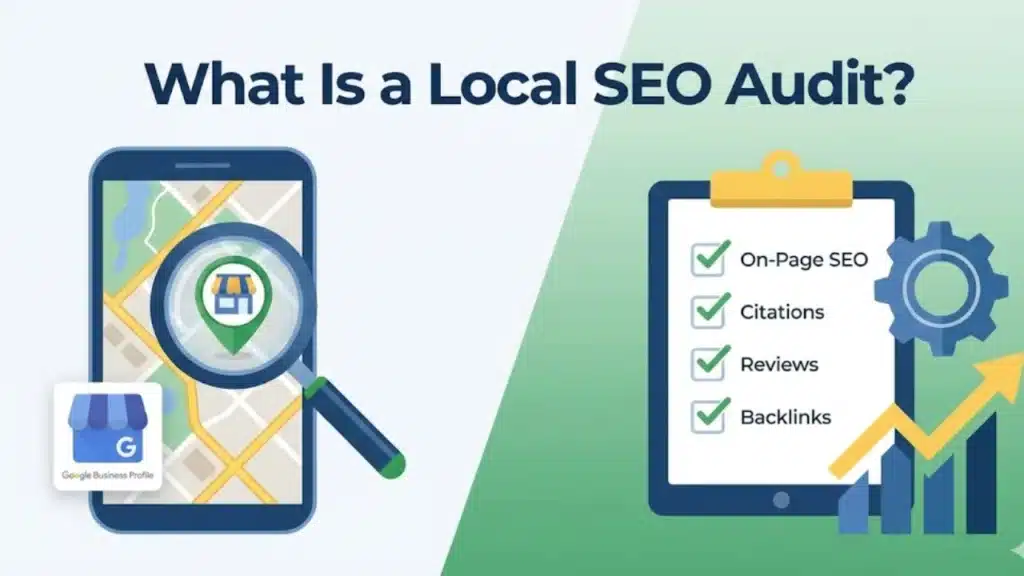
A Local SEO Audit is a structured analysis of all the factors affecting your visibility in local search results. This includes:
- Google Business Profile performance
- Map pack and local pack presence
- Website authority and relevance
- Technical and on-page SEO
- Reviews and reputation quality
- Local citations and directory listings
- Local backlinks and brand mentions
- Competitor positioning
- Mobile experience
- AI/SGE readiness
The purpose of the audit is to uncover weaknesses, find opportunities, and build a clear action plan to improve local rankings.
Why a Local SEO Audit Is Essential
Local search is competitive, especially for service-based businesses. Even small issues can block your visibility in Google Maps and local results. An audit helps:
- Discover ranking obstacles
- Fix incorrect business info
- Improve Google Business Profile performance
- Strengthen local authority signals
- Detect ranking drops early
- Identify fake competitor listings
- Improve local landing pages
- Boost trust through EEAT signals
- Enhance user experience
A proper audit ensures your business appears where your customers are searching.
How Local Search Works in 2025-2026
Local rankings depend on a blend of factors. Understanding these helps you evaluate your strengths and weaknesses.
Proximity
How near is your business to the searcher?
Relevance
How closely your business matches the search intent.
Prominence
How trustworthy and authoritative your online presence is.
Google uses signals from your website, Google Business Profile, citations, content quality, reviews and real user behavior to decide which businesses appear in Google Maps and the local pack.
Quick 10-Minute Local Visibility Check
Before starting the full audit, perform this quick evaluation:
- Search your business name + city.
- Confirm your Google Business Profile appears correctly.
- Make sure your primary business category is accurate.
- Check your address, phone number and hours.
- Look for listing duplicates.
- Test your website on mobile.
- Check if your homepage clearly mentions your main service and location.
- Open your main location page and review its content quality.
- Confirm your GBP has updated photos.
- Search your main service + “near me” and check if you appear in the results.
If you find issues, continue with the full audit below.
Complete Local SEO Audit Checklist (Step-by-Step)
This is the core of the guide, a full audit covering every ranking factor.
1. Business Information & NAP Consistency
Your Name, Address and Phone Number (NAP) must be consistent everywhere.
Review:
- NAP on your website
- NAP on Google Business Profile
- NAP on directory listings
- Old or duplicate phone numbers
- Outdated addresses
- Missing suite numbers
- Incorrect business categories
Fix:
- Standardize formatting
- Remove duplicates
- Correct all mismatches
NAP consistency strengthens trust signals and avoids Google confusion.
2. Google Business Profile Audit
Your Google Business Profile (GBP) is central to local search visibility.
Review:
- Primary and secondary categories
- Business description quality
- Services added
- Products listed (if applicable)
- Business hours and holiday hours
- Phone number and website link
- Messaging enabled
- Booking or appointment links
- Service area accuracy
- High-quality photos and videos
- Logo and cover image
- Q&A section
- GBP posts consistency
- Review responses
- Local attributes (e.g., wheelchair accessible, women-owned)
A complete, well-maintained GBP often outranks strong websites.
3. Citation & Directory Audit
Citations help verify your business information across the internet.
Review:
- Top citations for NAP accuracy
- Industry-specific directories
- Local business directories
- Duplicate listings
- Old listings from previous addresses
- Inconsistent phone numbers
Fixing citation errors improves authority and ranking stability.
4. Reviews & Reputation Audit
Reviews influence both local pack rankings and user trust.
Review:
- Total number of reviews
- Average star rating
- Recent reviews
- Review velocity (how often they come in)
- Negative review patterns
- Review keywords customers use
- Responses posted by the business
Improve:
- Ask for reviews after service
- Respond professionally to all reviews
- Encourage photo reviews
- Resolve recurring complaints
Strong reputation signals improve local relevance and prominence.
5. Local Keyword & Search Intent Alignment
Evaluate whether your content aligns with what local customers search for.
Review:
- Main services + city combinations
- “Near me” variations
- Local questions customers ask
- GBP description alignment
- On-page titles and headings
- Service-area content
This ensures your business appears for both direct and discovery searches.
6. Website Content Audit
Your website must support your GBP and reinforce relevance.
Review:
- Strong homepage with clear local signals
- Local landing pages for each service area
- Service descriptions with local relevance
- Local FAQs
- Testimonials from local customers
- Photos of real work or team
- Embedded map
- Click-to-call and click-to-route buttons
- Location schema markup
Many businesses rank poorly because their website lacks location-rich content.
7. Technical SEO for Local
Technical performance affects both organic and local rankings.
Review:
- Core Web Vitals
- Mobile usability
- Page speed
- Indexing errors
- Sitemap and robots configuration
- Redirects
- Duplicate content
- HTTPS security
- Image optimization
- URL cleanliness
A fast, mobile-friendly site improves user satisfaction and ranking stability.
8. Backlink & Local Authority Audit
Local prominence is influenced by authority signals.
Review:
- Local backlinks
- Niche directories
- Partnerships and sponsorships
- Guest posts and brand mentions
- Anchor text patterns
- Toxic links
Backlinks from local organizations have strong weighting for local visibility.
9. Local Landing Page Audit
Each location page should be a complete resource.
Must include:
- City + service in title
- Clear, helpful content
- Unique text (not duplicated across locations)
- Local photos and staff images
- Business address and phone
- CTA buttons
- Service area details
- Google Map embed
- Local testimonials
- Location-based FAQs
- LocalBusiness schema
High-quality local pages significantly improve local pack rankings.
10. Competitor & Spam Analysis
Your competitors influence your own visibility.
Review:
- Their categories
- Review count
- Review velocity
- Photos and updates
- Keyword stuffing in business names
- Duplicate or fake listings
- Backlink strength
- Their location page quality
Competitor audits reveal ranking opportunities and gaps.
11. AI Search & SGE Readiness
Local SEO is evolving with AI overviews.
Optimize for:
- Clear business identity
- Well-structured content
- Detailed FAQs
- Local intent coverage
- High-quality GBP images
- Descriptive reviews
- Schema markup
- Consistent entity information across the web
Businesses that optimize for AI search will dominate future rankings.
12. Reporting, Scoring & Action Plan
End your audit with a structured roadmap.
Steps:
- Score each audit category.
- Rank tasks by impact vs. effort.
- Create a 30-day, 60-day and 90-day improvement plan.
- Track performance from GBP Insights, GA4 and ranking tools.
This turns your audit into a strategic growth plan.
Mini Industry Examples
Local Restaurant
Focus on photos, menu accuracy, peak-time reviews, attributes and mobile speed.
Plumbing Company
Focus on emergency service keywords, service area clarity and call-to-action visibility.
Dental Clinic
Focus on expertise, reviews, medical schema, staff bios and appointment features.
These examples show how audits must adapt to each business type.
How Often Should You Run a Local SEO Audit?
- Small businesses: every 6 months
- Competitive industries: every 3 months
- Multi-location brands: monthly
- After any ranking drop or GBP update
Regular audits keep your business ahead of competitors.
Frequently Asked Questions
What is a Local SEO Audit?
A full evaluation of your Google Business Profile, website, citations, reviews and ranking signals.
How do I perform a Local SEO Audit?
Follow a structured process reviewing categories like GBP, SEO, technical performance, reviews and citations.
Does a Local SEO Audit improve rankings?
Yes. It identifies issues blocking visibility and provides fixes that boost performance.
How long does an audit take?
Anywhere from 30 minutes to several hours, depending on business size and number of locations.
Need a Professional Local SEO Audit?
If you want a detailed audit, ranking analysis and a personalized action plan for your business, you can contact our team anytime.
📞 Call: +92 3092894995
📧 Email: Info@professionalseoservices.net
🔗 Local SEO Services: https://professionalseoservices.net/local-seo/
📍 Google Business Profile: https://goo.gl/maps/gGevxAVhtsqkzDaY9
We evaluate every ranking factor and deliver a complete audit with recommendations tailored to your location, competition and industry.